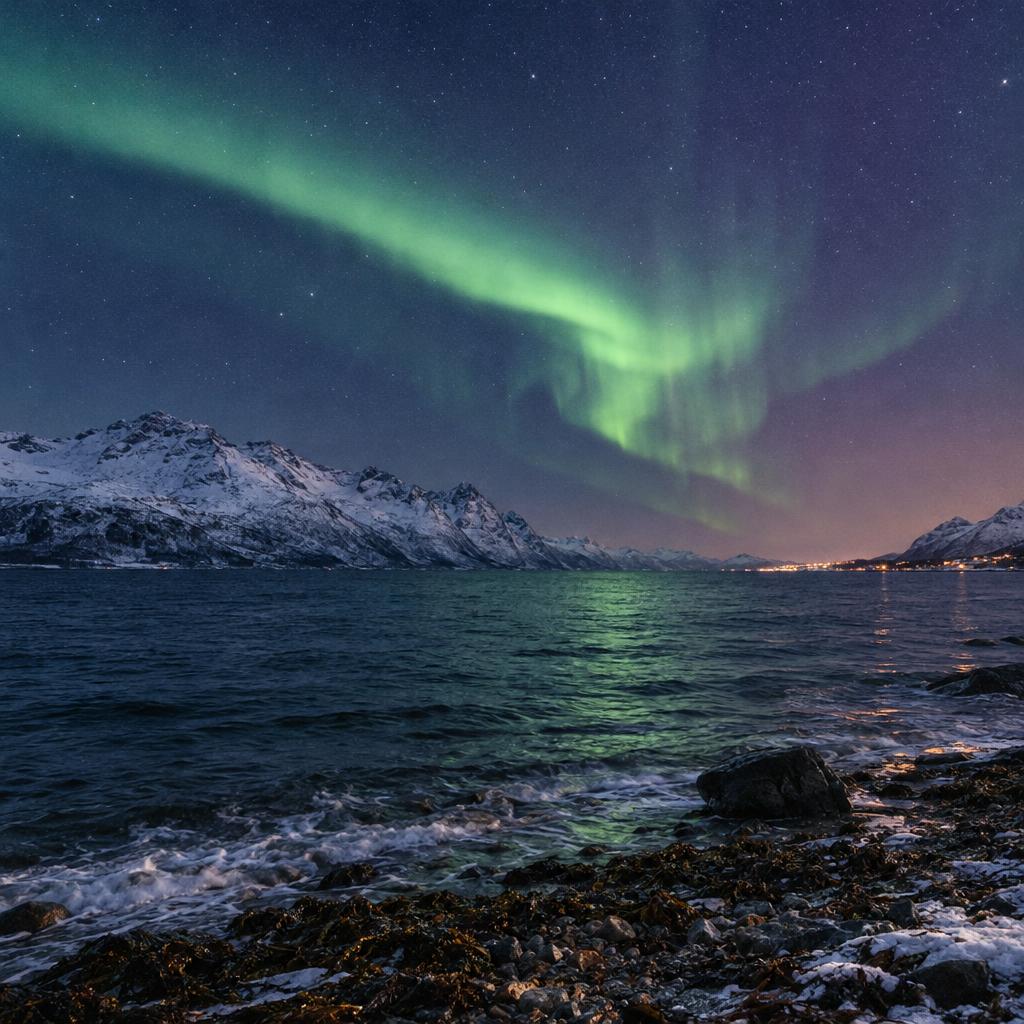
Polar Night, Northern Lights
Norway
In January the sun stays below the horizon at Tromsø, on its island far above the Arctic Circle. Midday brings a long blue dusk, the snow glows violet, and the lights of the harbour shine on black water. The fjords and the steep white peaks around the town stand close and silent, and the cold bites at your cheeks the moment you step outside.
Then the night comes down. Out past the last streetlamp, pale green ribbons of aurora bend, fade and flare again across the sky, and you tilt your head back and watch them move over the snow.
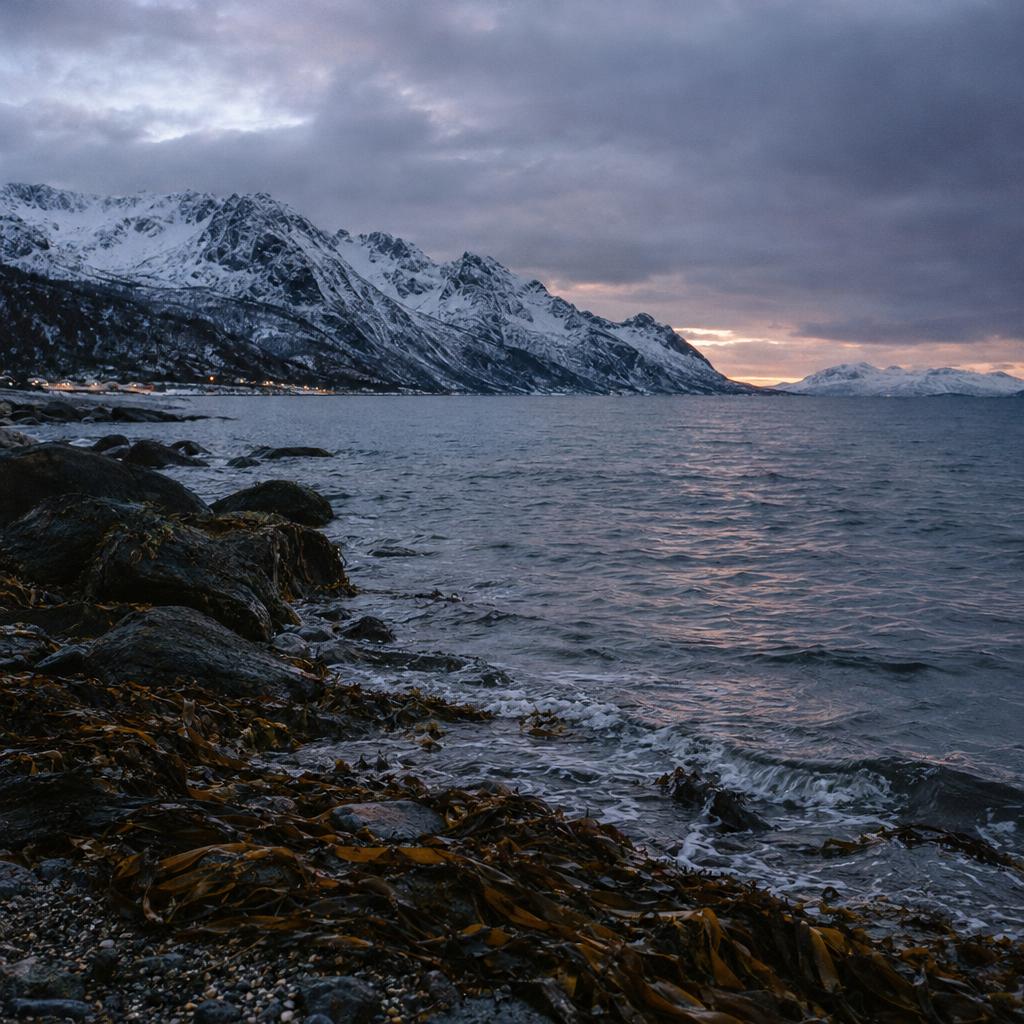
Tromsø (Kvaløya), Norway
Tromsø's fjords are black water under granite, and on Kvaløya the peaks run straight into them, snow in every gully, the road you drove in on bending along the edge. You have the car for the whole stretch, so every headland that opens is yours to pull over at. Step out and the cold arrives clean, smelling of salt and wet stone. Kelp lies in dark ribbons on the shingle, and jagged ridgelines stand above you in the low, pale blue light of the short days.
A small wave turns over and over under a sky that, by late afternoon, has gone the colour of a bruised plum. Then the dark comes properly. Out here, with Tromsø's glow behind a ridge, the stars thicken until the sky has depth.
You stand on the shore in your heaviest layers, five of you, breath hanging in front of your faces, the water slapping the rocks somewhere below. You give your eyes twenty minutes to adjust. A pale green smear may start low over the peaks and lift, brightening, drifting.